
Hedge share is the fraction of the tape that is market makers hedging their own book, rather than real participants trading. When it is low, a move has room to run. When it is high, the move is the hedging — mechanical, and fragile.
Every strike in the options book carries gamma, and gamma is an obligation. As price moves through a strike, the market maker who sold those options has to buy or sell a known number of shares to stay hedged. That number is not an opinion. It falls directly out of the gamma at the strike and the size of the move, and it has to be executed into the same tape everyone else is trading on.
Dark Horse computes that forced quantity live, strike by strike. The result is the hedge wedge on the chart: the cumulative shares dealers must buy above spot and sell below it, drawn as a profile from the current price outward.
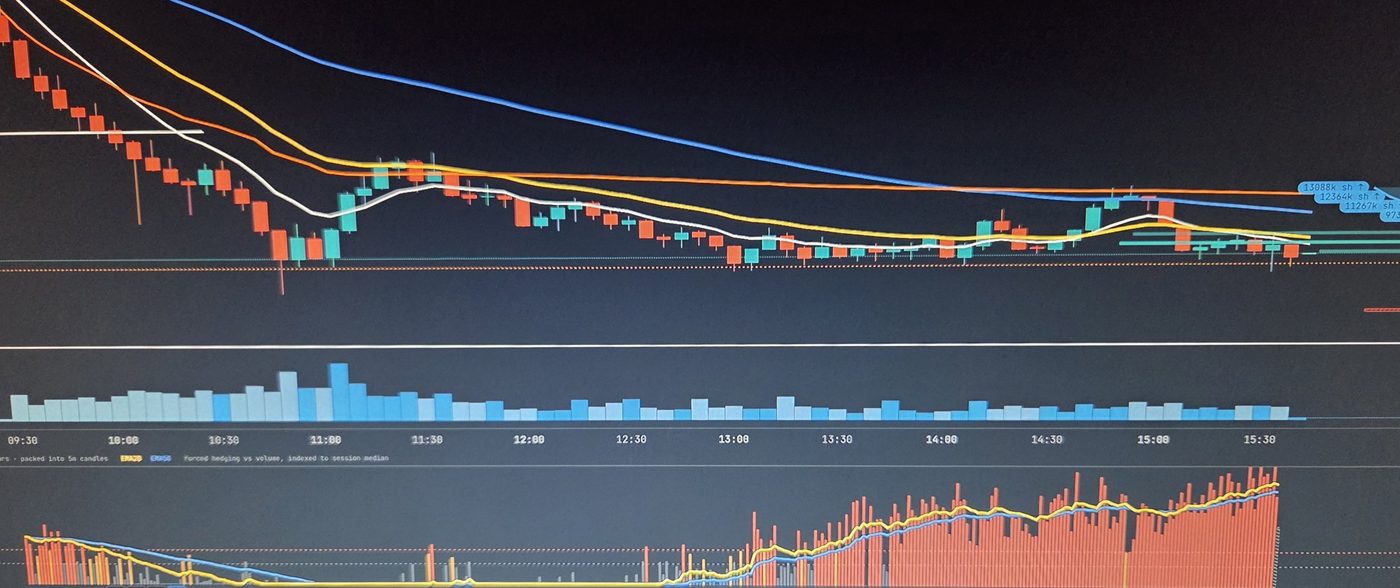
Shares-forced-to-hedge is only half the story. Ten thousand forced shares means something different on a day that trades two million shares a minute than on a day that trades two hundred thousand. So the pane divides: forced hedging ÷ actual traded volume, then indexes the ratio to the session's median so that 1.0 always means “a normal amount of the tape is hedging, for today.”
The exact band boundaries Dark Horse trades off are part of the engine and are not published.
It seems backwards. Dark Horse is a dealer-positioning tool, so surely more dealer activity is more signal? No. The positioning levels tell you where the forced flow will be. Hedge share tells you whether forced flow is currently drowning out everyone else. The best directional trades happen when the levels are known and the tape is still being set by real participants — low hedge share — because that is when a move can extend past the first wall instead of being pinned to it.
In the live system Dark Horse grew out of, hedge share at the moment of entry is one of the strongest single conditions we have measured. On the same morning entry signal, trades taken in the low band won at a materially higher rate and carried several times the per-trade expectancy of trades taken in the ordinary band — and the gap widened further when the directional read disagreed. Trades taken in the elevated band lost money in every case we recorded, and the live system no longer takes them.
The exact bands and figures are part of the engine and stay private. The result comes from one instrument over one month and is in-sample — a direction, not a promise. The methodology is the same as the K4 exit engine study.
Hedge share is drawn as its own pane under the price chart, in the same session-indexed units every day, so a reading of 0.5 on a quiet Tuesday means the same thing as 0.5 on a CPI morning. It is a condition, not a signal: it does not tell you which way to trade, it tells you whether the tape is in a state where a directional trade can work. Pair it with the walls for the where and the gamma flip for the regime.
Not investment advice. For educational purposes only. Market maker positioning levels, not trade signals.